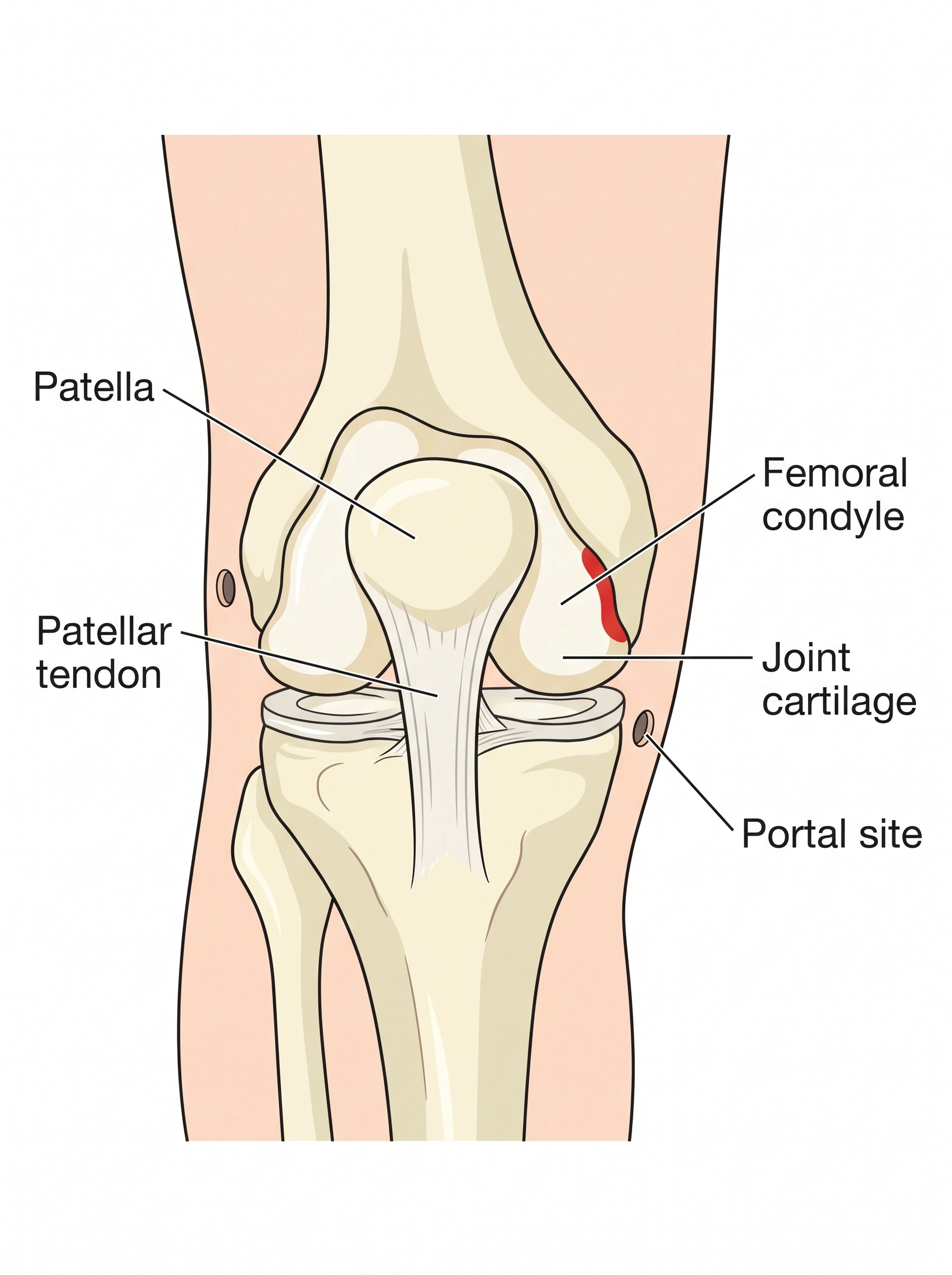
Dr. Rossy performs knee arthroscopy in Princeton, a procedure using a small camera through tiny incisions to see and treat problems inside the knee. It is used after non-surgical care for specific issues such as a meniscus tear that catches or loose fragments.
William Rossy performs knee arthroscopy in Princeton when it is the right step, and reviews every alternative with you first.
What is Knee Arthroscopy?
Knee arthroscopy is a procedure in which the surgeon inserts a small camera, called an arthroscope, through a tiny incision to view the inside of the knee on a screen.
Thin instruments pass through other small incisions to treat what is found.
It is used for specific problems such as a meniscus tear that catches the knee, loose fragments of cartilage, or to prepare a defect for restoration. It is not a treatment for general arthritis pain.
Because the incisions are small, many people go home the same day. The value of arthroscopy depends on matching it to the right problem.
What happens during Knee Arthroscopy, step by step?
Under anesthesia, the surgeon fills the knee with fluid, inserts the arthroscope, and inspects the joint.
Depending on findings, the surgeon may trim or repair a meniscus, remove loose bodies, or address a cartilage defect. The incisions are closed with a stitch or small strips. Dr. Rossy will explain what was found and done after the procedure.
What is recovery like after Knee Arthroscopy?
Many people go home the same day and walk with support soon after.
Recovery depends heavily on what was done inside the knee. A simple trimming often allows a return to light activity within a couple of weeks, while a repair requires a longer, protected course, according to general guidance from the American Academy of Orthopaedic Surgeons. These are ranges, not promises. Your surgical team will give you a plan based on your procedure.
Read the full guide to preparing for surgery →
Your own recovery instructions come from the office and are specific to you. This page describes the general course, not a plan to follow.
Who performs knee arthroscopy in Princeton?
William Rossy is a board certified orthopedic surgeon who performs knee arthroscopy in Princeton, NJ. Fellowship trained at Harvard-Massachusetts General Hospital (Sports Medicine Fellowship). Dr. Rossy sees patients at the practice in Princeton; appointments can be requested through this site.
What do patients ask most?
What problems can knee arthroscopy fix?+
Is knee arthroscopy outpatient surgery?+
Does arthroscopy help arthritis pain?+
How long is recovery after knee arthroscopy?+
How do payments work?
Contact the office to confirm insurance participation.
Fellowship trained at Harvard-Massachusetts General Hospital (Sports Medicine Fellowship). Sees patients in Princeton.
About Dr. Rossy →